The Staff at Fox & Sons’ Eastbourne Branch
How a disagreement over property viewings developed into a formal complaint about the conduct of a senior branch employee.
When we were preparing to leave the flat we had been renting, Fox & Sons was one of three letting agents instructed to find a new tenant for the property.
We agreed to allow viewings during the final month of our tenancy, subject to two straightforward conditions:
We would be present
We would remain at the property during every viewing.
Viewings required prior agreement
Each appointment would be arranged and agreed with us in advance.
These were reasonable conditions, and both the landlord and the other two letting agents respected them. Our experience with the Fox & Sons Eastbourne Lettings Branch Partner, however, was very different.
Our experience
In our view, his conduct became aggressive, demanding, persistent and disrespectful. He repeatedly failed to respect the arrangements we had set and continued pressing for access and further viewings.
The situation escalated to the point where I had to firmly tell him to back off and informed the landlord that all viewings were being stopped with immediate effect.
Despite this, the agent later entered the flat and continued requesting additional viewings. By that stage, we stopped engaging with him directly and raised the matter with the landlord and the estate agents instead.
Read the full account of the Branch Partner’s conductFrom the branch complaint to the Area Director
Initially, we believed the agent’s behaviour may have resulted from pressure being applied by the landlord. However, after legal proceedings were initiated against the landlord, the landlord’s solicitor distanced the landlord from the agent’s conduct and apologised for the distress and harassment we said had been caused.
That brought us to the next stage of the complaint and the main subject of this article: the Fox & Sons Area Director and the way the complaint was handled.
This section is a first-person account of the author’s experience. Statements describing conduct or its effect reflect the author’s opinion and interpretation of the documented events.
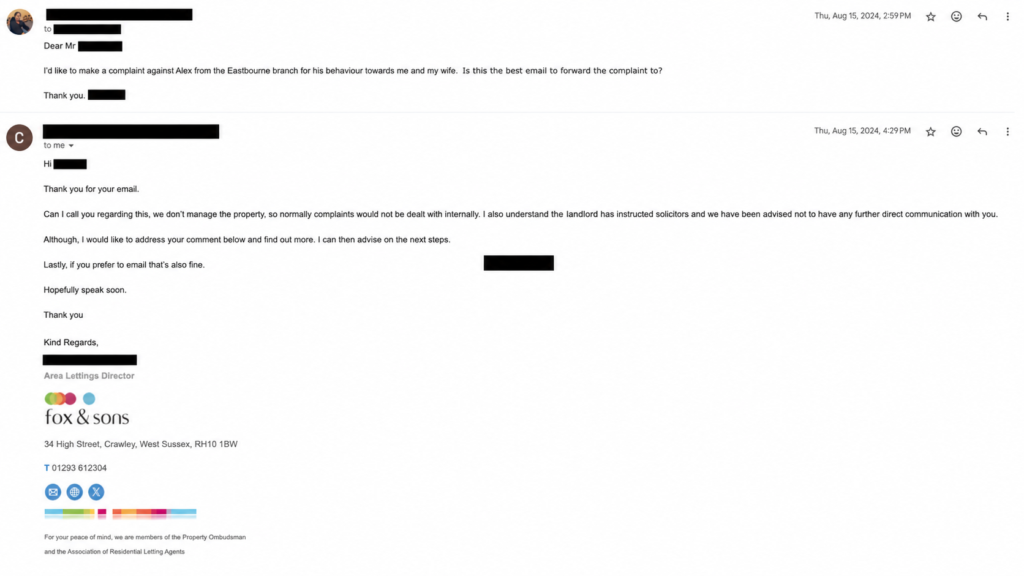
An Unverified Allegation Presented as Fact
Look closely at this reply. The Area Director almost immediately states that an incident had occurred outside the office, despite apparently having made no effort to establish whether that claim was true.
I understand an incident occurred outside of the office…
When I first read the email, I was confused. I initially considered the possibility that the branch agent had provided him with inaccurate information.
The allegation had not been checked
Even if the information had been passed to him by somebody else, it is deeply concerning that an Area Director responsible for investigating complaints would repeat such a serious and unverified allegation as fact before checking the evidence or asking me for my account.
In my view, this was an irresponsible and completely unacceptable way to begin a complaints investigation.
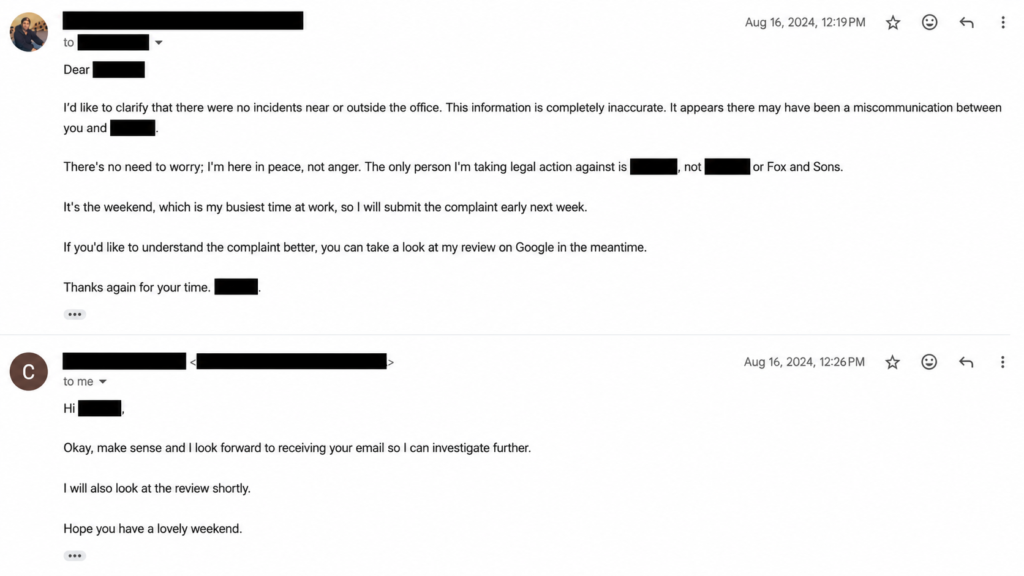
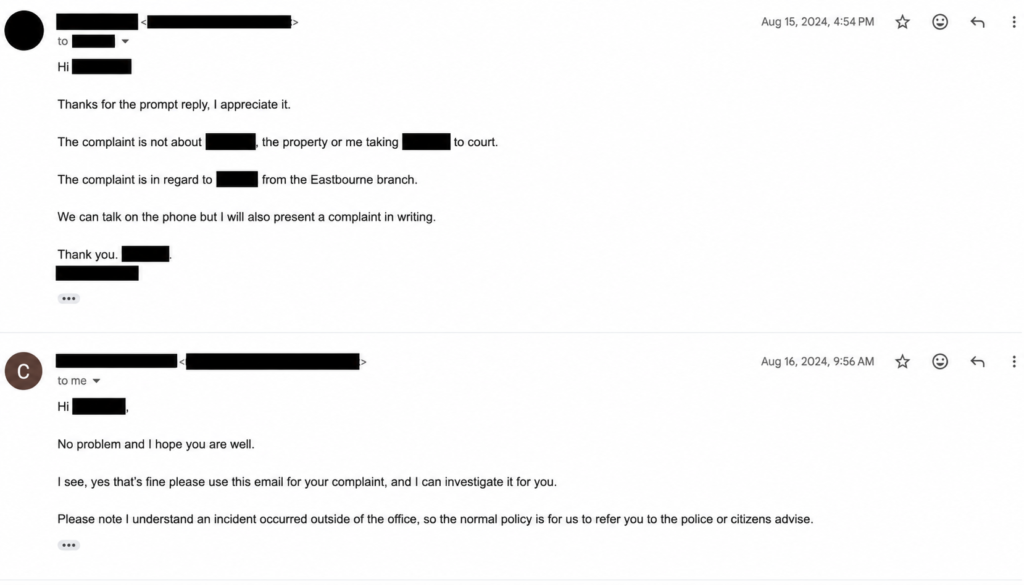
Calmly Challenging an Unsupported Claim
The correspondence shows that I disputed the allegation before I had even been given the opportunity to explain my complaint.
A calm and polite correction
As the correspondence above shows, I challenged the claim immediately, calmly and politely. I made it clear that no incident had taken place near or outside the office and suggested that the Area Director may have received inaccurate information.
Looking back, I regret being quite so accommodating. Before I had even been given the opportunity to explain my complaint, he had already introduced an unsupported allegation and appeared ready to redirect the matter away from Fox & Sons.
A complaint approached with a closed mind
In my view, that was not the conduct of someone approaching a complaint with an open mind. Instead of first asking for my account and checking the facts, he repeated an unverified claim that immediately placed me on the defensive.
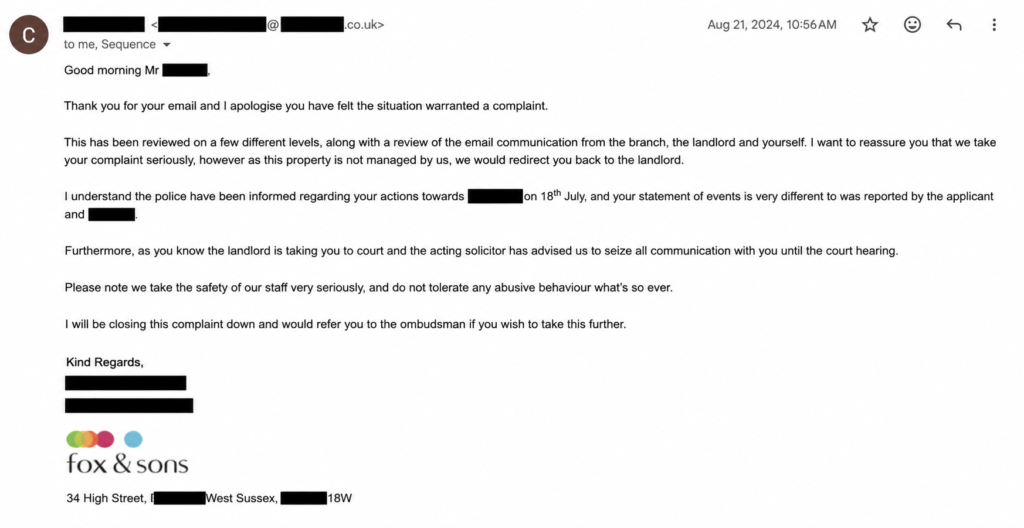
The Complaint Was Closed Before It Was Properly Investigated
In my view, this is the point at which the complaint was unfairly shut down without a proper, balanced or impartial investigation.
Our complaint was immediately minimised
The Area Director began by saying that he was sorry we “felt” the situation warranted a complaint. In my view, that wording minimised the seriousness of what we had reported.
My wife had been sufficiently concerned by the agent’s conduct that she contacted the police. The response nevertheless treated the matter as though we had simply overreacted.
A questionable claim that the matter had been reviewed
The email stated that the complaint had been reviewed “on a few different levels”.
However, we later submitted a Data Subject Access Request. This required the company to disclose the personal data and internal records it held about me.
Its data protection officer subsequently confirmed that there were no records supporting the account presented in the email. In my view, that raises serious questions about what investigation, if any, had actually taken place.
I understand the police have been informed regarding your actions…
A serious police allegation was presented as fact
The email stated that the police had been informed about my alleged actions during an incident.
I maintained from the beginning that no such incident had occurred. The Area Director later confirmed in writing that the police had not been notified and that no police action had been taken.
A serious and potentially damaging allegation had therefore been presented to me as fact without first being verified.
The court proceedings were described incorrectly
The email also stated that the landlord was taking me to court.
In reality, I had initiated the legal proceedings against the landlord. This was another important fact that could easily have been checked before the complaint response was issued.
The focus was shifted onto alleged abusive behaviour
The Area Director then warned that the company would not tolerate abusive behaviour.
This appeared to imply that I had behaved abusively, despite my complaint being about the conduct of their own agent and despite my wife having contacted the police because of the way that agent had behaved towards us.
The complaint was simply closed
The complaint was then closed without my concerns being meaningfully addressed and without any explanation of what evidence had supposedly been reviewed.
Why I found this response deeply concerning
Rather than examining the conduct of the employee complained about, the Area Director relied on unverified allegations, misstated the court proceedings and immediately placed us on the defensive.
In my opinion, employees are unlikely to be held properly accountable when complaints about their conduct are handled in this way.
This experience caused me to question whether the conduct we encountered at branch level reflected wider weaknesses in the company’s complaints culture.
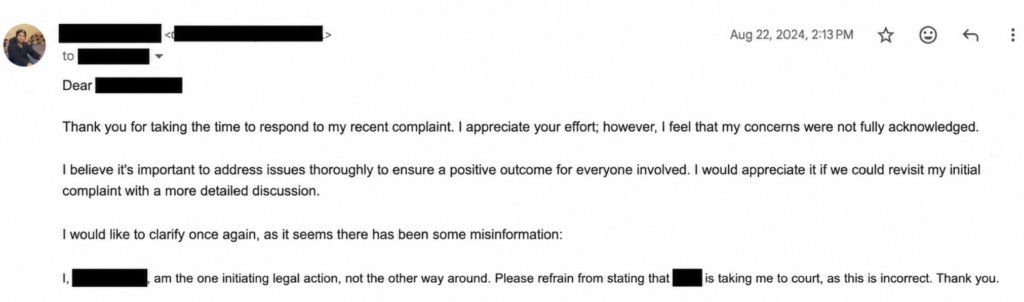
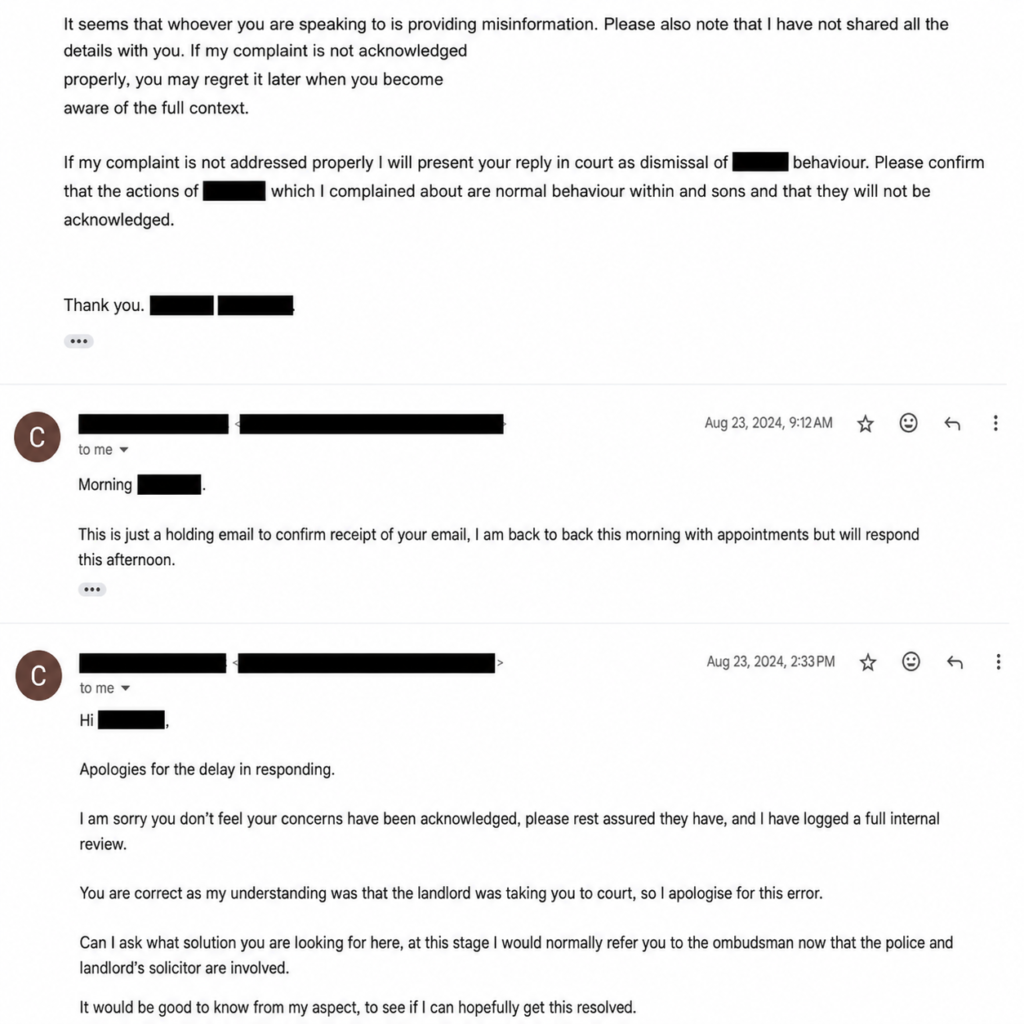
A More Reasonable Reply — But Serious Questions Remained
With hindsight, this response initially appears more constructive. However, the later DSAR disclosure raised serious questions about whether the statements made in it were accurate.
The claim that a full internal review had been logged
The Area Director stated that he had “logged a full internal review”.
However, the company’s own data protection officer later confirmed that there was no information on its systems relating to such a review. No internal review records, complaint logs or supporting notes were disclosed.
In my view, the claim that a full internal review had been logged is extremely difficult to reconcile with the company’s later confirmation that it held no records of that review.
What outcome was I seeking?
The Area Director then asked what solution I was looking for.
The answer should have been straightforward: a proper investigation into the conduct I had complained about, an honest response based on verified facts and, where wrongdoing was established, a meaningful apology.
What the complaint process should have delivered
A proper examination of the original complaint
A response based on checked and documented facts
Accountability where employee misconduct was established
A sincere and meaningful apology where appropriate
My conclusion
Instead, I was left feeling that the complaint process was being managed through unsupported statements rather than a genuine investigation.
In my opinion, the handling of this matter was shameful, deeply concerning and embarrassing for someone occupying such a senior position.
DSAR Delays, Redactions and Refusals: How to Challenge Every Excuse
Independent, non-profit website. This site is not affiliated with, endorsed by, or connected to Fox & Sons, Sequence (UK) Limited or Connells Group. It carries no advertising, sells nothing, and makes no profit — it exists solely as a free public-interest consumer resource. Nothing here is legal advice.
New to Subject Access Requests? Start with The DSAR: Your Most Powerful Tool, then come back here when the response lands.
You sent your DSAR. Now the organisation is asking for more time, demanding ID it already has, redacting whole pages, or refusing outright. Some reasons are legitimate. Many are vague excuses that deserve to be challenged — and the difference decides whether you get the internal records that matter or a folder of emails you already had.
The golden rule: the organisation must assess your request individually. It cannot extend deadlines or apply exemptions automatically just because responding is inconvenient. Every excuse below comes with the exact wording to fire back.
“Your request is complex”
They say: “Due to the complexity and volume of your request, we require an additional two months to respond.”
The one-month deadline can be extended by up to two further months — but only where the request is genuinely complex or the individual has made multiple rights requests. Genuine complexity means things like archived systems that are technically difficult to search, large amounts of particularly sensitive data needing careful review, or real legal and confidentiality questions requiring specialist advice.
A request is not automatically complex because it involves a lot of information. And they must notify you of the extension, with reasons, within the original month — an extension announced after the deadline has already passed is a warning sign in itself.
You reply: “Please explain which specific aspects of my request you consider complex, what work remains outstanding, and why that work could not reasonably be completed within the original statutory period.”
“We hold a large amount of information about you”
They say: “We hold a significant volume of information and require you to narrow the scope of your request.”
They can ask you to clarify what you want. You do not have to reduce your request — you remain entitled to everything they hold about you. But do reply promptly, because the response clock can pause while they wait for your answer. Note: the clock only pauses for clarification about the information requested, not side questions like your preferred delivery format — and they should ask promptly, not on the eve of the deadline.
You reply: “I confirm that I require the full scope of personal data described in my original request. To assist your searches, the principal date range is [date] to [date], and the matter concerns [account, property or complaint]. This clarification does not reduce or withdraw any part of my original request.”
“We need proof of your identity”
They say: “We cannot begin processing your request until you provide photographic identification and proof of address.”
ID checks are legitimate where there’s reasonable doubt about who’s asking — but they must be proportionate. A company that already knows you through an established account, a verified email address, or months of ongoing correspondence should not suddenly demand a passport. The clock generally starts once they receive what they reasonably require — so late, excessive ID demands are a classic stalling tactic.
You reply: “Please explain why the identification already held on my account, together with my correspondence from the registered email address, is insufficient and why each additional document requested is necessary.”
Tip: if you do send ID, redact anything they don’t reasonably need, as long as what remains is enough to verify you.
“The information contains other people’s personal data”
They say: “This correspondence cannot be disclosed because it contains third-party personal data.”
Third-party rights are real — but they rarely justify withholding an entire document. In most cases the company can redact the other person’s identifying details and still disclose the parts about you. The objective should be disclosure of your data with targeted redactions, not blanket suppression.
You reply: “I accept that genuinely identifying information relating exclusively to third parties may require redaction. However, please disclose my personal data and the substance of all correspondence about me, using targeted redactions where necessary rather than withholding entire documents.”
“The material is legally privileged”
They say: “Certain documents have been withheld because they are subject to legal professional privilege.”
Sometimes true — privilege covers confidential communications with a legal adviser for the purpose of legal advice, and certain documents created for litigation. But privilege does not automatically cover everything the legal department touched: not every email copied to a solicitor, not ordinary business correspondence involving a lawyer, not documents merely labelled “confidential,” and not pre-existing documents just because they were later sent to a lawyer.
You reply: “Please confirm the general category of each item withheld, the date of the item, and whether you rely upon legal advice privilege or litigation privilege. I am not requesting disclosure of the privileged legal advice itself, but I ask that all reasonably separable non-privileged personal data be provided.”
“The information is not your personal data”
They say: “The documents identified by our searches do not constitute your personal data.”
Your name appearing in a document doesn’t automatically make the whole document your personal data — a mass email with you in the recipient list says nothing about you. But an internal email discussing your conduct, complaint, account, credibility, property or treatment almost certainly contains your personal data — even though it was never sent to you. Those internal emails are usually exactly what you’re after.
You reply: “Please confirm whether the material was reviewed to determine whether it discusses, evaluates, identifies or records information about me, rather than considering only whether my name appears within it.”
“You’re entitled to your data, not complete documents”
Broadly correct — a DSAR gives you a right to your personal data, not to every original document. Extracts, redacted copies, transcripts and structured summaries can be acceptable, provided the personal data itself is included and remains understandable. Stripping out so much context that the data becomes meaningless is not an adequate response.
“Disclosure would prejudice negotiations”
They say: “The information records our position in negotiations with you and has therefore been withheld.”
There is a narrow exemption for records of an organisation’s intentions in negotiations with you — for example, an insurer’s internal note of its maximum settlement figure. It does not permit withholding every record connected to a dispute.
You reply: “Please identify which information records your intentions in negotiations and explain, in general terms, how disclosure would be likely to prejudice those negotiations. Please disclose all other personal data that can reasonably be separated from that information.”
“The information concerns management planning”
Another narrow exemption: genuine forward-looking management forecasting or planning (confidential redundancy plans, for instance) where disclosure would be likely to prejudice the business. It is far less likely to apply just because managers discussed a particular customer or complaint. They should show real planning activity and identifiable prejudice.
“Disclosure could prejudice an investigation”
Legitimate in the right circumstances — revealing investigative methods or witness information in an active fraud investigation, say. But the mere existence of a complaint, allegation or investigation does not exempt every record connected with it. Separable information should still be disclosed.
“The request is manifestly unfounded or excessive”
They say: “We consider your request to be manifestly unfounded or excessive and will not be responding.”
This is a serious position and the threshold is high — for example, a requester who offers to withdraw for money, or a request that’s clearly malicious. A request is not unfounded or excessive merely because it’s connected to a complaint, might assist litigation, follows an earlier DSAR, is inconvenient and time-consuming, or because the requester used angry language or is considered “difficult.” They must assess individually, keep evidence of the decision, and be able to justify it to the ICO.
You reply: “Please provide the evidence and specific factors relied upon in concluding that my request is manifestly unfounded or excessive. Please also confirm whether you have considered responding partially, narrowing any allegedly excessive element, or charging a reasonable administrative fee rather than refusing the request entirely.”
“The information has been deleted”
They say: “We no longer hold the information because it was deleted in accordance with our retention policy.”
Organisations aren’t expected to keep data forever, and they can’t be made to recreate what’s genuinely gone. But ask: what type of information was deleted, when, under which retention period, and — crucially — before or after your DSAR was made. Which live, archived and backup systems were searched? Do copies survive in individual mailboxes?
Know this one cold: deliberately altering, erasing, destroying, blocking or concealing information to prevent its disclosure after a DSAR has been made can be a criminal offence under section 173 of the Data Protection Act 2018. Routine deletion that would have happened anyway is different — which is exactly why the timing questions matter.
“We only searched the central complaint system”
They say: “We have provided all information identified on our central system.”
Not good enough if your request covered more. Individual employee mailboxes, branch inboxes, area and regional management, compliance departments, telephone systems, archived accounts, messaging platforms, paper files, external complaint-handlers — reasonable searches should cover the places your data actually lives. In our own case study, it was the absence of any call records in the DSAR response that dismantled an account which relied on a phone call.
You reply: “Please confirm which systems, departments, employee accounts, shared mailboxes, search terms and date ranges were searched. Please also confirm whether archived records, call-recording systems, paper files and records held by processors acting on your behalf were considered.”
Warning signs in a DSAR response
Push back with further questions where the company:
- Uses the word “complex” without identifying any complexity
- Extends the deadline after the original month has already expired
- Asks for clarification, or demands ID it already possesses, at the last moment
- Redacts entire pages rather than individual names or passages
- Labels everything touched by its legal department as privileged
- Claims internal emails aren’t your personal data because they weren’t sent to you
- Provides only correspondence you already received
- Searches only the branch involved while ignoring head office and regional management
- Gives no explanation of which systems and mailboxes were searched
- Says records were deleted without saying when, or under which retention policy
- Refuses the whole request where only a small part could be exempt
- Fails to tell you how to challenge the decision (internally, to the ICO, or in court)
Exemptions should be applied to particular information — never as a blanket reason to conceal a whole record or dodge the request entirely. A refusal must normally be explained, with your challenge routes set out.
Copy-and-paste challenge to an incomplete DSAR response
Dear Data Protection Officer,
Thank you for your response to my Subject Access Request.
The disclosure appears to be incomplete and/or contains information that has been withheld without sufficient explanation.
Please confirm:
1. The systems, databases, individual email accounts, shared mailboxes and departments searched.
2. The search terms and date ranges used.
3. Whether branch, area, regional, compliance, legal and head-office records were searched.
4. Whether call recordings, call logs, archived records, paper files and records held by processors were considered.
5. The legal basis for each category of withheld or redacted information.
6. Whether targeted redaction was considered instead of withholding complete documents.
7. The date and applicable retention policy for any information said to have been deleted.
8. Whether any information was withheld on the basis of legal professional privilege, third-party data, negotiations, management planning or another statutory exemption.Where an exemption is relied upon, please explain how it applies to the particular information withheld and provide all reasonably separable personal data that is not covered by that exemption.
Please also treat this correspondence as a request for an internal review of the completeness and lawfulness of your response.
Yours faithfully,
[Name]
If they still won’t budge
Send the challenge letter, give them a reasonable window (14 days is fair for a review of their own response), and if the answer is still silence or stonewalling, escalate — that’s what the regulator is for. Our guide to complaining to the ICO covers exactly when and how, and the Templates Library has the rest of your paper trail ready to copy.
My Fox & Sons / Connells Group Complaint: A Full Case Study

Public-interest case study
My Fox & Sons / Connells Group Complaint
How a viewing dispute became a data rights case
The original complaint
Pressure around viewings, property access and communication near the end of a tenancy.
The disputed statement
Company correspondence said police had been informed regarding my actions.
The written clarification
In 2026, an Area Director confirmed: “the police were never notified.”
Summary
This is a first-person account of a real consumer dispute involving Fox & Sons, Sequence UK Ltd and Connells Group. I am publishing it as a public-interest case study to show how written complaints, escalation routes and data rights can work in practice.
In July 2024, near the end of a tenancy, a dispute arose about viewings being arranged at the flat I lived in with my wife. Fox & Sons were not the managing agent for the property, but a branch employee was involved in arranging viewings before we moved out.
My complaint was about pressure around viewings, access to the property, communication, and the way the situation was later described.
In August 2024, after I complained, correspondence from the company referred to an alleged incident outside the office and later stated that the police had been informed regarding my actions towards a branch employee.
I disputed that from the beginning.
“For absolute clarity, the police were never notified.”
This case study explains what happened, what was written at the time, what I challenged, and what finally worked.
Scope and independence
This site is independent and is not affiliated with Fox & Sons, Sequence, Connells Group or any related company. Nothing on this page is legal advice.
This page does not allege fraud, criminal conduct or dishonesty by any individual. It sets out the documentary record and explains the steps I took.
Background: the original issue
The dispute began during the final stage of my tenancy.
The property was being marketed for new tenants before we moved out. A Fox & Sons branch employee attended the flat to take photographs and arrange viewings.
My position was simple: my wife and I did not want anyone entering the flat without us present. We were also working long hours and asked for viewings to be arranged around our availability.
In my complaint, I said we had explained that Fridays and Saturdays were especially difficult because of work commitments, and that we were more flexible from Monday to Thursday.
My complaint was that this was not respected properly.
I said that viewings were pushed too heavily, that there was pressure to allow access without us being present, and that viewings were arranged in a way that disrupted us during an already stressful move-out period.
That was the original consumer complaint.
The first complaint
On 15 August 2024, I emailed the company’s Area Lettings Director and asked whether I could submit a complaint about the behaviour of a branch employee.
The Area Lettings Director replied the same day. He said the property was not managed by Fox & Sons, so complaints would not normally be dealt with internally. However, he also said he was willing to hear more and advise on next steps.
I replied and clarified that the complaint was not about the landlord, the property itself, or my separate dispute with the landlord. It was about the conduct of the branch employee.
The Area Lettings Director then confirmed that I could use that email address for my complaint and that he could investigate it.
The first reference to an alleged incident
On 16 August 2024, before I had submitted my full written complaint, the Area Lettings Director wrote:
“Please note I understand an incident occurred outside of the office, so the normal policy is for us to refer you to the police or citizens advise.”
Email dated 16 August 2024
I immediately disputed that.
I replied the same day and wrote that there had been no incident near or outside the office. I said the information was completely inaccurate and that there may have been a miscommunication.
I also made clear that I was not pursuing legal action against Fox & Sons at that stage. I said the legal dispute was with the landlord, not with the branch employee or the company.
This was an important moment because the complaint had started to shift away from the viewing issue and towards an alleged incident that I said had not happened.
My formal complaint
On 20 August 2024, I submitted my formal written complaint. In that complaint, I set out my version of events.
I said that when the branch employee first attended the flat, I made clear that we did not want viewings to happen without us present. I also said that we tried to provide alternative availability and that we were not refusing all viewings.
I complained that, despite this, there was pressure for viewings to continue and for access to be allowed without us being there.
I also said that a large number of viewings were arranged on a Saturday without proper agreement from us, and that my wife had to change her plans to accommodate them.
I explained that other agencies had handled viewings differently by calling us, asking for suitable times, and respecting our routine.
The complaint also referred to a later phone call during the final week of the tenancy. I said that while my wife and I were on the way to a viewing, the branch employee called several times asking where we were and urging us to hurry. I accepted that I raised my voice and used explicit language, which I said I regretted, but I explained that this happened after I felt pushed repeatedly.
The key point of the complaint was that I believed the wider context had been ignored.
Connells Group Compliance was copied in
After I submitted the complaint, a Connells Group compliance and complaints contact replied.
That reply explained that the department copied was for residential sales and that the Lettings Complaints Team had been copied in to assist.
This matters because the complaint was no longer just a branch conversation. It had been copied into wider complaints channels connected to Sequence / Connells Group.
The complaint response
On 21 August 2024, the Area Lettings Director responded to my complaint.
The response said the matter had been reviewed on a few different levels, including email communication from the branch, the landlord and me.
The response then said that because the property was not managed by Fox & Sons, I should be redirected back to the landlord.
The most important part of the response was this sentence:
“I understand the police have been informed regarding your actions towards [branch employee] on 18th July, and your statement of events is very different to what was reported by the applicant and [branch employee].”
Complaint response dated 21 August 2024
The same email also said that the landlord was taking me to court, that a solicitor had advised the company to cease communication with me until the court hearing, and that the company took staff safety seriously.
The complaint was then closed, and I was referred to the ombudsman.
I disputed several parts of that response.
Why I challenged it
I challenged the response because I believed it contained important inaccuracies.
First, I disputed the police wording.
Second, I disputed the suggestion that the landlord was taking me to court. My position was that I was the one preparing legal action against the landlord.
Third, I did not accept that my complaint had been properly addressed. In my view, the focus had moved away from the conduct I complained about and onto allegations about me.
The company later accepted one of those points.
“You are correct as my understanding was that the landlord was taking you to court, so I apologise for this error.”
Follow-up dated 23 August 2024
That same email said my concerns had been acknowledged and that a full internal review had been logged.
However, the same email still referred to “the police and landlord’s solicitor” being involved.
That is why the police issue remained important.
The complaint was not over
Although the complaint had initially been closed, the correspondence continued.
-
30 Aug
2024A holding response
The Area Lettings Director said he was looking into a few things and would revert the following week.
-
3 Sep
2024Internal investigation
He wrote that my comments were noted and were being investigated internally because the company did not want the situation to happen again for all parties concerned.
-
Sep
2024A direct written challenge
I wrote to the branch employee and forwarded the email to the Area Lettings Director, who replied: “I think that’s a sensible way forward.”
-
Nov
2024Formal escalation
I asked for the correct complaints route and ombudsman information. The complaint moved to the Sequence Lettings Complaints team and a Divisional Managing Director.
-
3 Dec
2024A written apology
The Divisional Managing Director acknowledged the pressure around viewings and said the Eastbourne process would be reviewed.
On 3 September 2024, the Area Lettings Director wrote:
“Please rest assured your comments are noted and are being investigated internally, as we don’t want this to happen again for all parties concerned.”
Email dated 3 September 2024
He also acknowledged that it had been a stressful situation for me and my wife. At that point, I replied that I wanted to move on from the matter and focus on the separate dispute with the landlord.
The September email to the branch employee
In September 2024, I also wrote directly to the branch employee about what had been said. I then forwarded that email to the Area Lettings Director.
The Area Lettings Director replied: “I think that’s a sensible way forward.”
In my opinion, that reply is important because it shows that, at that stage, the company was still engaging with me constructively and did not treat my written challenge as unreasonable.
The matter returned in November 2024
In November 2024, after a separate tenancy deposit dispute had been resolved, I returned to the Fox & Sons complaint.
I asked for the matter to be escalated and for the correct complaints route, including ombudsman referral information.
The Area Lettings Director copied in the Sequence Lettings Complaints team and said the complaint should move to the next stage. He wrote that he had made the Divisional Managing Director aware of the complaint and asked for a response to be issued in his name.
On 3 December 2024, the Divisional Managing Director responded.
“I can see that you and your wife are very unhappy with the pressure put on you to show viewings around the property and for this please accept my apologies. I will look at the process here in Eastbourne and we will learn from any mistakes that we made.”
Divisional Managing Director, 3 December 2024
That apology was significant.
It did not resolve every issue, but it did acknowledge the pressure around viewings and said the process would be looked at.
The unresolved issue: police involvement
Even after the December 2024 apology, one issue remained unresolved for me.
The company had written in August 2024 that the police had been informed regarding my actions towards a branch employee.
I had disputed that from the outset.
The issue mattered because police involvement is serious. It changes the tone of a complaint. It can make a customer feel intimidated, and it can affect how others view the dispute.
In my opinion, if a company states or repeats that the police were informed about a customer, it should be able to identify the record supporting that statement.
That is why I later used my data rights.
The Subject Access Request
I later submitted a Subject Access Request.
The purpose was simple: I wanted to see what personal data was held about me, including internal correspondence, complaint notes, records of third-party contact, and any record connected to the alleged police involvement.
This was the turning point.
A Subject Access Request forces an organisation to search for and provide personal data it holds about you, subject to the legal rules and exemptions that apply.
For consumers, it can be one of the most useful tools when a dispute involves statements made about them.
The 2026 written clarification
In 2026, after the matter was pursued further, the company’s Area Director confirmed in writing:
“For absolute clarity, the police were never notified.”
That sentence is the reason this case study matters.
The documentary record showed two positions:
Company correspondence stated that police had been informed regarding my actions.
The company confirmed in writing that the police were never notified.
I make no allegation about anyone’s intent.
The documents are reproduced so readers can see the record for themselves and understand why keeping everything in writing matters.
Key documents
The following six items form the central written record. Redacted screenshots can be placed into the marked areas before publication.
16 August 2024 email
The email saying an incident was understood to have occurred outside the office.
21 August complaint response
The response stating that police had been informed regarding my actions.
23 August follow-up
The correction about who was taking whom to court, while still referring to police and solicitor involvement.
3 September internal review
The email saying my comments were noted and being investigated internally.
3 December director response
The apology for pressure around viewings and commitment to review the Eastbourne process.
2026 written clarification
The later written statement: “For absolute clarity, the police were never notified.”
My opinion
In my opinion, being told that the police had been informed about my actions, when the company later confirmed that the police were never notified, was distressing and intimidating.
In my opinion, a customer should not have to use a legal data request to get clarity about whether the police were actually contacted.
In my opinion, this case also shows why vague statements should always be challenged in writing. If someone says the police were involved, ask for the date, the force, the reference number, the officer details, and the record held.
That is my opinion, based on the documents and timeline set out above.
What worked
-
Keeping everything in writing
The entire case depends on the written record. Emails, dates, complaint responses, acknowledgements, and later clarifications all mattered. Without the paper trail, this would have become one person’s word against another’s.
-
Challenging inaccuracies immediately
When I was told there had been an incident outside the office, I challenged it immediately. When I was told the landlord was taking me to court, I challenged that too. One of those points was later corrected in writing.
-
Asking for the complaint to be escalated
The complaint did not end at branch level. It moved from the Area Lettings Director to the Lettings Complaints team and then to a Divisional Managing Director. That escalation produced a written apology about the pressure around viewings.
-
Using a Subject Access Request
The Subject Access Request was the key tool. It forced the issue away from vague wording and towards records. If an organisation has made or repeated a serious statement about you, a DSAR can help reveal what records actually exist.
-
Separating fact from opinion
The facts are the documents, dates and written responses. My opinion is how those documents affected me and what I believe they show. Keeping those separate makes the complaint clearer and safer to publish.
What I would do differently
Looking back, I would make every complaint shorter, colder and more structured.
I would avoid emotional language. I would ask for particulars earlier. I would write something like:
Please identify the record relied upon for the statement that police were informed. Please confirm the date of contact, the police force contacted, the method of contact, any reference number, and the name or role of the person who made the report.
Example request for particulars
That kind of wording is more powerful than anger.
What other consumers can learn
If you are complaining about Fox & Sons, Connells Group, Sequence, or any other estate agent, keep the complaint focused.
- Write down dates
- Keep screenshots
- Ask for final responses
- Request evidence behind serious claims
If something has been said about you and you believe it is inaccurate, consider making a Subject Access Request.
If the organisation fails to handle your data properly, consider escalating to the Information Commissioner’s Office.
If the complaint is about estate agency service, ask for the company’s final viewpoint letter and consider escalating to The Property Ombudsman where appropriate.
A viewing complaint became a case about the record
This case began as a complaint about viewings.
It became more serious because correspondence referred to police involvement.
The documents now show why written complaints and data rights matter.
In 2024, I was told the police had been informed.
In 2026, the company confirmed in writing that the police were never notified.
That is the record.
How Not to Handle a Complaint
An Area Director responsible for reviewing and responding to complaints should approach the process fairly, accurately and professionally. In my view, this case provides a clear example of how not to handle a complaint.
Untrue Statements
Statements were made that were later shown to be untrue.
Unsupported Claims
Claims were introduced without supporting evidence or documentation.
Unverified Allegations
False or unverified allegations were presented as though they were established facts.
This section represents the author’s opinion based on the documented correspondence and evidence held by the author.